Aavistus · Country Posture · Structural commentary · 2026-05-09

It looks like withdrawal. It's actually repricing.

The cultural commentary about younger generations and work has been wrong in a specific direction. The vocabulary suggests withdrawal — quiet quitting, soft life, tang ping, 996 and the rest. The data says something different. Younger workers report higher stated commitment to work than any prior cohort. What they have changed is the deal they accept and the question they ask while accepting it.

Two structural shifts and one cognitive shift, all measurable.

The deal moved without their consent

US labor productivity per hour has more than doubled since 1980. The same worker today produces 2.34× the 1980-equivalent output per hour [1]. Cognitive load per hour has risen materially across that window — more skill, more credentialing, more software-mediated work, more discontinuous re-skilling.

Across the same window, the implicit-employment side of the contract eroded. Defined-benefit pension access in the US private sector is now 15% (2024) [2] — a small minority of workers. The promise of "stay 30 years and we carry you in retirement" has been replaced by "manage your own 401(k) outcomes." Employer-provided training has retreated; the responsibility for skill-currency moved onto the worker. Tenure expectations have shortened; layoffs cycle independent of business cycles.

That is not the cohort entering with different values and breaking the deal. That is the deal being re-priced asymmetrically against the cohort entering it.

Their stated commitment did not change

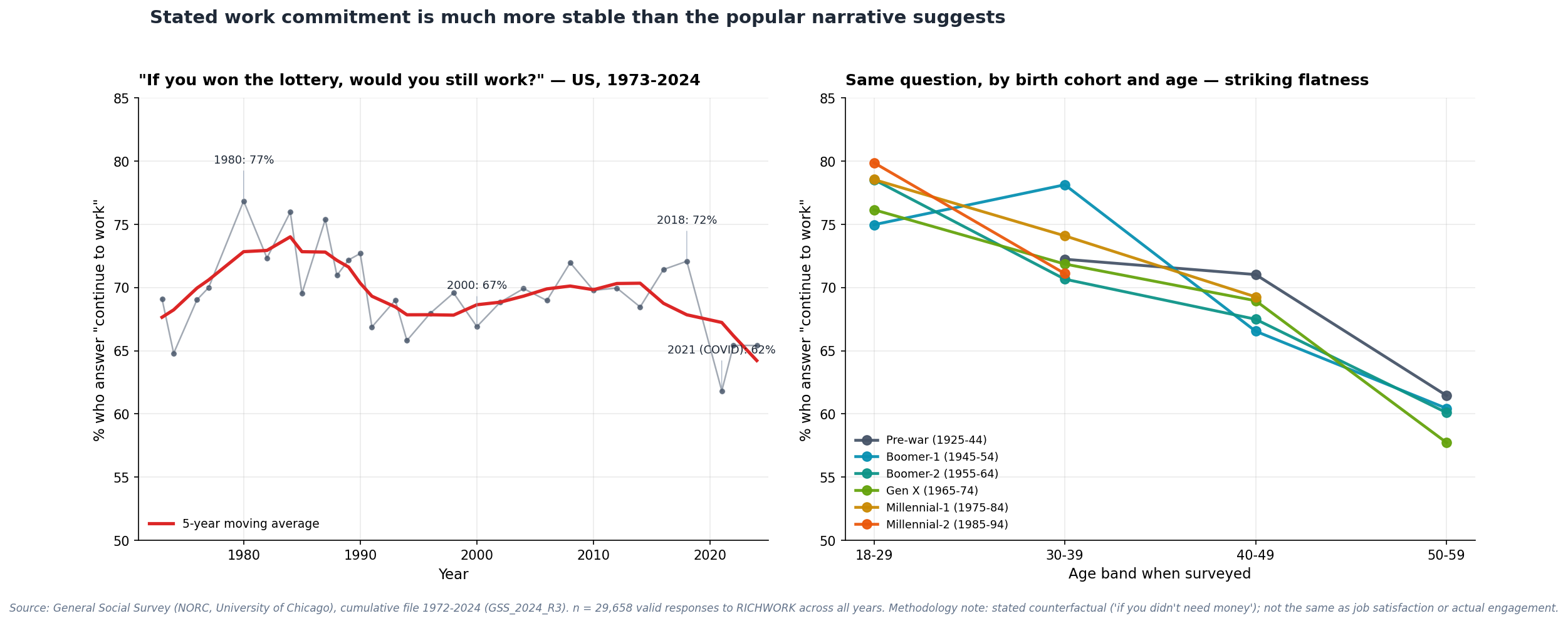
This is the finding that breaks most generational narratives. The General Social Survey's RICHWORK question — "if you were to get enough money to live as comfortably as you would like for the rest of your life, would you continue to work or would you stop working?" — has been asked across 30 waves since 1973, n = 29,658 [3].

Among 18-29-year-olds, the answers across cohorts:

Pre-war: 67% · Boomer: 75-78% · Gen X: 76% · Millennial: 78-80% · Gen Z: 76%

Stated work commitment among young adults has been remarkably stable for 50 years. Millennials at 18-29 actually report the highest theoretical commitment of any cohort. The "Gen Z won't work" narrative does not survive contact with the GSS data.

The gap between the popular narrative and the data is informative. Younger workers are not refusing to work. They are refusing to work under the old terms of the deal — terms that the productivity-side has filled in but the implicit-employment-side has emptied out.

The data behind the question

If you won the lottery, would you still work? US, 1973-2024, by birth cohort and survey year. The COVID-year dip (2021, 62%) is visible; the longer-arc cross-cohort stability is the story.

GSS RICHWORK by birth cohort and survey year, US 1973-2024

Source: General Social Survey 1972-2024 (NORC at the University of Chicago, cumulative release GSS_2024_R3), variable RICHWORK; n = 29,658.

What did change is the cognitive default

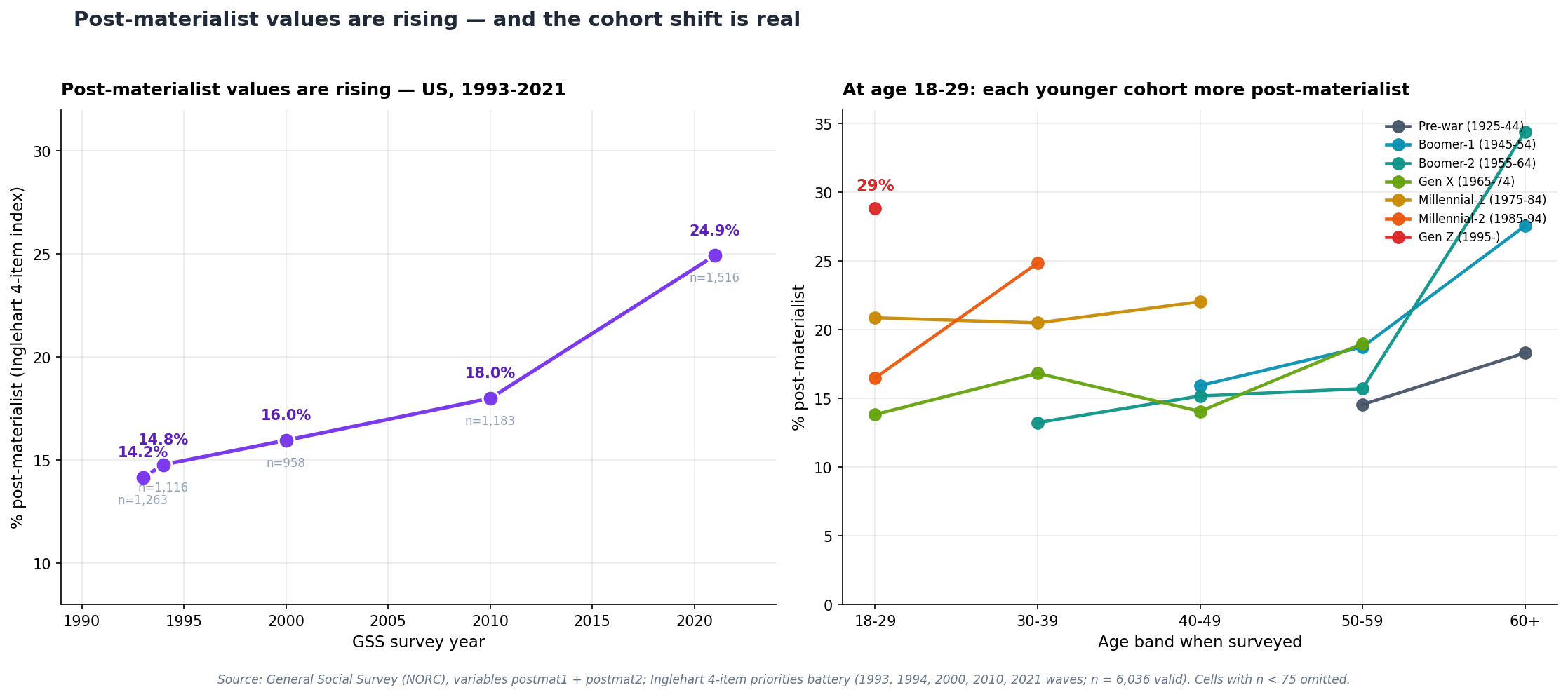
Inglehart's post-materialism index — the long-running measurement of self-expression / autonomy / voice priorities versus survival / order / fighting-prices priorities — has nearly doubled in the US between 1993 (14.2%) and 2021 (24.9%) [4]. Each younger cohort at the same age reports more post-materialist values than the older cohort did at the same age.

Gen Z (1995-2004) at age 18-29 reports 31% post-materialist — roughly 2× the boomer cohort at the same age (16%) and the highest cell in the dataset.

This is not the cohort being lazy. It is the cohort having internalized a different default question. "Is this arrangement OK for me?" has displaced "How do I fit myself to this arrangement?" as the routine internal frame. That is a real cognitive shift, measurable, and consistent with 50 years of intergenerational value-change theory.

The shift has both sides. On the pro-social side: more agency over personal welfare, more rejection of asymmetric deals, normalization of mental-health attention, refusal of unpaid overwork as automatic. On the costly side: lower friction tolerance, more interpersonal conflict over what was previously absorbed silently, more fragility under structural pressure. Both are real. The cohort isn't morally better or morally worse than the cohort that came before it; it is internally evaluative by default in a way the prior cohort wasn't.

The cognitive shift, in numbers

Post-materialist values (self-expression, voice) over materialist values (order, fighting prices) — by survey year and birth cohort. Gen Z at 18-29 is the highest cohort × age cell in the dataset.

GSS Inglehart post-materialism index by cohort and age, US 1993-2021

Source: General Social Survey (NORC), variables postmat1 + postmat2 — Inglehart 4-item priorities battery; n = 6,036 valid responses across 1993, 1994, 2000, 2010, 2021 waves.

What the vocabulary catalogue actually documents

Quiet quitting, soft life, tang ping, kotoilu, hygge, 996. These terms get the press attention. They are not wrong, but they are downstream — cultural texture documenting the surface of what the structural data says is going on underneath. Vocabulary metrics are noisy in their own right: language churn is constant; new compounds appear and old ones fade for reasons unrelated to underlying change; marketing cycles amplify some terms while leaving others in specialty corners.

Hygge is the cleanest illustration of the noise. The Danish concept appeared in Danish writing in the 19th century; the Old Norse etymological roots are older still. But the Anglo-mainstream uptake is post-2014, triggered substantially by Meik Wiking's 2016 bestseller [5]. "Hygge" now appearing in English book corpora at hundreds of times its 1990 frequency overstates the cultural change because the 1990 baseline was specialty academic usage, not absent. The same critique applies to quiet quitting (Gallup-promoted research framing), soft life (TikTok-amplified marketing concept), and most of the recent additions.

So the vocabulary tells you what people are talking about. It does not tell you reliably what is changing. For that, you need the slower-moving signals: the structural-deal data, the stated-commitment data, the values data. Those tell a coherent story.
The mismatch is the analytical claim

Productivity per hour up. Wealth-payoff side of the contract down. Stated work commitment stable-to-rising. Cognitive frame shifted from "fit myself in" to "is this OK for me." Vocabulary documents the surface of the cognitive shift.

That is the picture. It is not a story about generational laziness or moral decline. It is a story about a contract being re-priced bilaterally — the employer-side withdrew first, more than 40 years ago, in pension architecture and tenure norms and training commitments. The employee-side is now repricing in response, with the new vocabulary documenting the negotiation.

What looks externally like withdrawal is, in the data, active repricing under a default frame of personal evaluation.

The framework's job is to name it correctly so the analysis does not get derailed by the vocabulary it produces.

Methodology + reproducibility. Every quantitative claim above traces to a primary source (footnotes below). Verification record + reproducibility scripts are public at the SentinelOS repository under intelligence/country_posture/research/work_sentiment/. No claim is made that cannot be reproduced from the cited data.

Sources

  1. US labor productivity: US Bureau of Labor Statistics, Nonfarm Business Sector Labor Productivity (Output per Hour of All Persons), series OPHNFB via FRED, Federal Reserve Bank of St. Louis. Index 100 = 2017; Q4 1980 reading = 49.82, Q4 2024 = 116.44, +133.7%. fred.stlouisfed.org/series/OPHNFB
  2. US private-sector DB pension access: US Bureau of Labor Statistics, 15 percent of private industry workers had access to a defined benefit retirement plan, The Economics Daily, 2024. Employee Benefits Survey, March 2024: 15% access, 11% participation in private sector. bls.gov
  3. GSS RICHWORK: General Social Survey 1972-2024 (NORC at the University of Chicago, cumulative release GSS_2024_R3), variable RICHWORK; n = 29,658 valid responses. gss.norc.org/get-the-data
  4. GSS post-materialism: General Social Survey (NORC), variables postmat1 + postmat2 — Inglehart 4-item priorities battery; n = 6,036 valid responses across 1993, 1994, 2000, 2010, and 2021 waves. gss.norc.org/get-the-data
  5. Hygge etymology + Anglo trigger: Wikipedia, Hygge, etymology section (citing Etymonline + Norden.org). Wiking, Meik (2016). The Little Book of Hygge: Danish Secrets to Happy Living. Penguin Random House.

Read the rest of the framework

Aavistus Country Posture scores G7-plus economies and East Asian leading-indicator cases on eight structural pillars and three cross-cutting diagnostic dimensions. The methodology and calibration record are public.